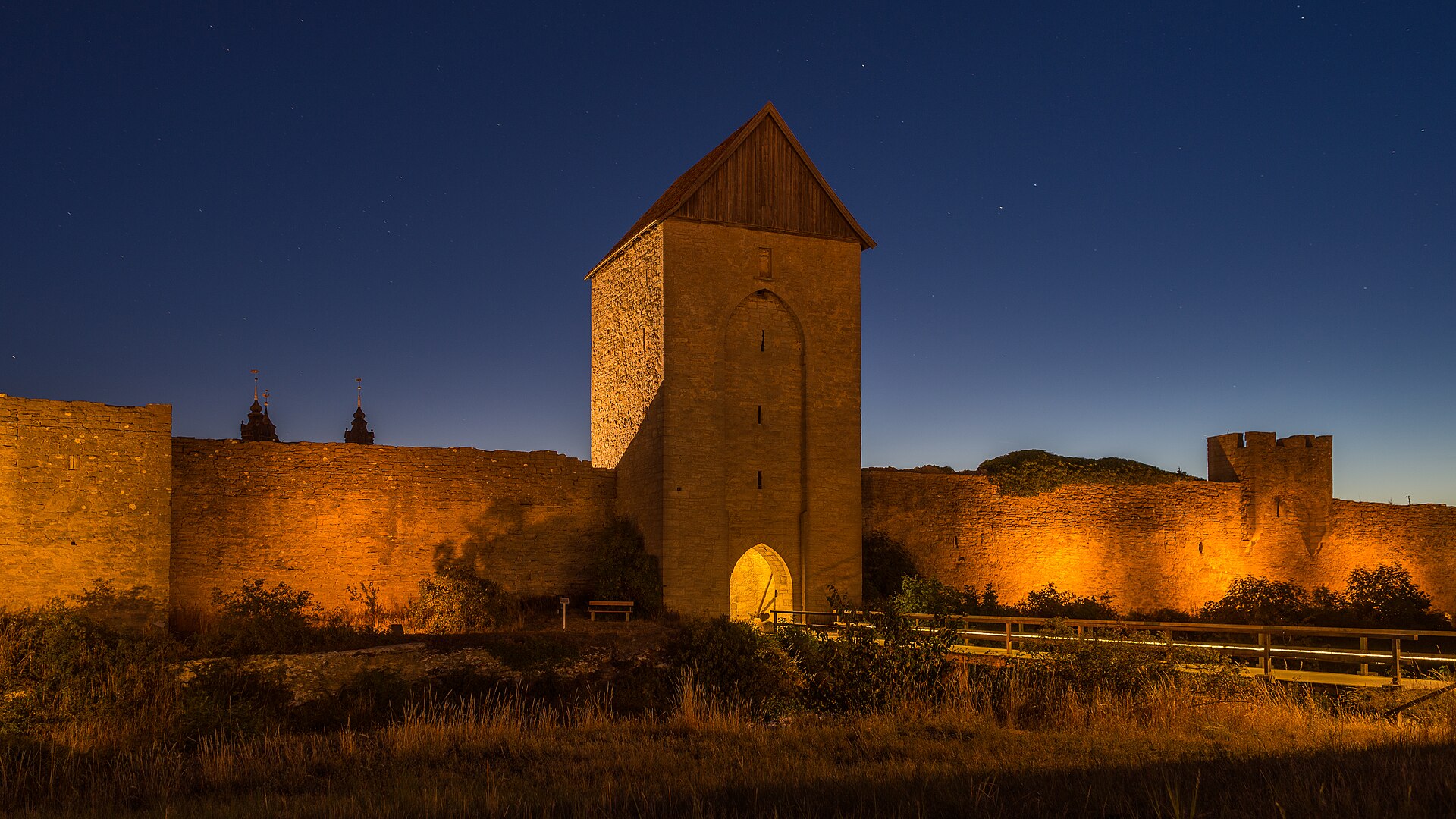
Gotland is worth the detour. Sweden’s largest island lies in the Baltic Sea, about 100 kilometers east of the mainland, and its main town, Visby, is a medieval trading port still enclosed by its stone wall. You get there by ferry from Nynäshamn, south of Stockholm, or from Oskarshamn, or on a short domestic flight. Visby can be seen in a day, but the rest of the island needs three days or more.
Visby is a walled medieval town you can walk in a day
By the 12th century, Visby dominated trade on the Baltic, and in the 13th century it grew from a seasonal trading place into a walled town of stone. From the middle of the 14th century it led the northeastern towns of the Hanseatic League, the alliance of German merchants and trading towns around the North Sea and the Baltic. When trade moved elsewhere, Visby slowly declined. The long decline left the church ruins, the town wall and the merchants’ houses standing.
The Hanseatic Town of Visby became a UNESCO World Heritage Site in 1995. Its limestone ring wall runs for 3.6 kilometers and is the best preserved town wall in Northern Europe. The wall was built in the 13th century, and a walk along it takes you past towers, gates and the dry moats outside.
Inside the wall, the streets still follow their medieval plan. Medieval Visby had more churches than any other town in Sweden, 15 inside the wall and two outside. Many of them fell into decay after the Reformation in the 1530s, and only St. Mary’s Cathedral is still used as a church. Several of the rest stand as ruins between the houses, among them St. Nicholas, St. Clement and St. Karin, the last one on Stora Torget, the main square.
The remains of more than 200 medieval warehouses and merchants’ homes still stand in the old town, and the limestone warehouses line three main streets that run parallel to the shore. Small wooden houses from the 18th and 19th centuries are found mostly in the eastern part of town. The walled town and its immediate surroundings cover 105 hectares (about 260 acres).
Medieval Week fills Visby every August
For one week every August, Visby holds its Medieval Week. The festival brings jousting, markets and encampments, and several of the church ruins become stages. Book a bed and the ferry early if you want to be there, or pick another week if you came for quiet streets.
Beyond Visby, see the sea stacks on Fårö and cycle the countryside
Outside the wall, Gotland is countryside and coast. Rent a bike or bring a car, and give yourself three days or more for the rest of the island.
Along the coast stand the raukar, tall limestone sea stacks. Fårö, a smaller island off northern Gotland, is reached by a road ferry from Fårösund. The most photographed sea stacks stand at Klajvika in the Langhammars nature reserve on Fårö, where just over 50 stacks rise from the shore and some are more than 8 meters tall. These sea stacks also appear on the back of the Swedish 200 kronor banknote.
Spend the rest of your time swimming, walking the shore and cycling the country roads. You can walk and swim almost anywhere, as long as you respect the land and the people who live there. That freedom is allemansrätten, Sweden’s right of public access.
Ferries to Gotland leave from Nynäshamn and Oskarshamn
Destination Gotland runs the Gotland ferries to Visby from two mainland ports: Nynäshamn, south of Stockholm, and Oskarshamn, farther south on the coast. The ferries carry cars as well as foot passengers. Timetables change with the season, so check sailings and book ahead, especially in summer.
If time is short, fly. Visby Airport has direct flights from Stockholm, and the airport lists the current routes and airlines on its website.
Spend a few days in Stockholm and on the islands of the Stockholm archipelago, then cross to Gotland at the end of your trip. Our guide to planning a trip to Sweden covers transport, money and the rest of the practical side.
Gotland at a glance
- What it is: Sweden’s largest island, with a land area of nearly 3,000 square kilometers
- Main town: Visby, a UNESCO World Heritage Site since 1995
- Getting there: ferry from Nynäshamn or Oskarshamn, or a flight to Visby
- How long: one day for Visby, three days or more for the island
- Getting around: on foot in Visby, by bike or car on the rest of the island
Last fact-checked: 15 October 2026