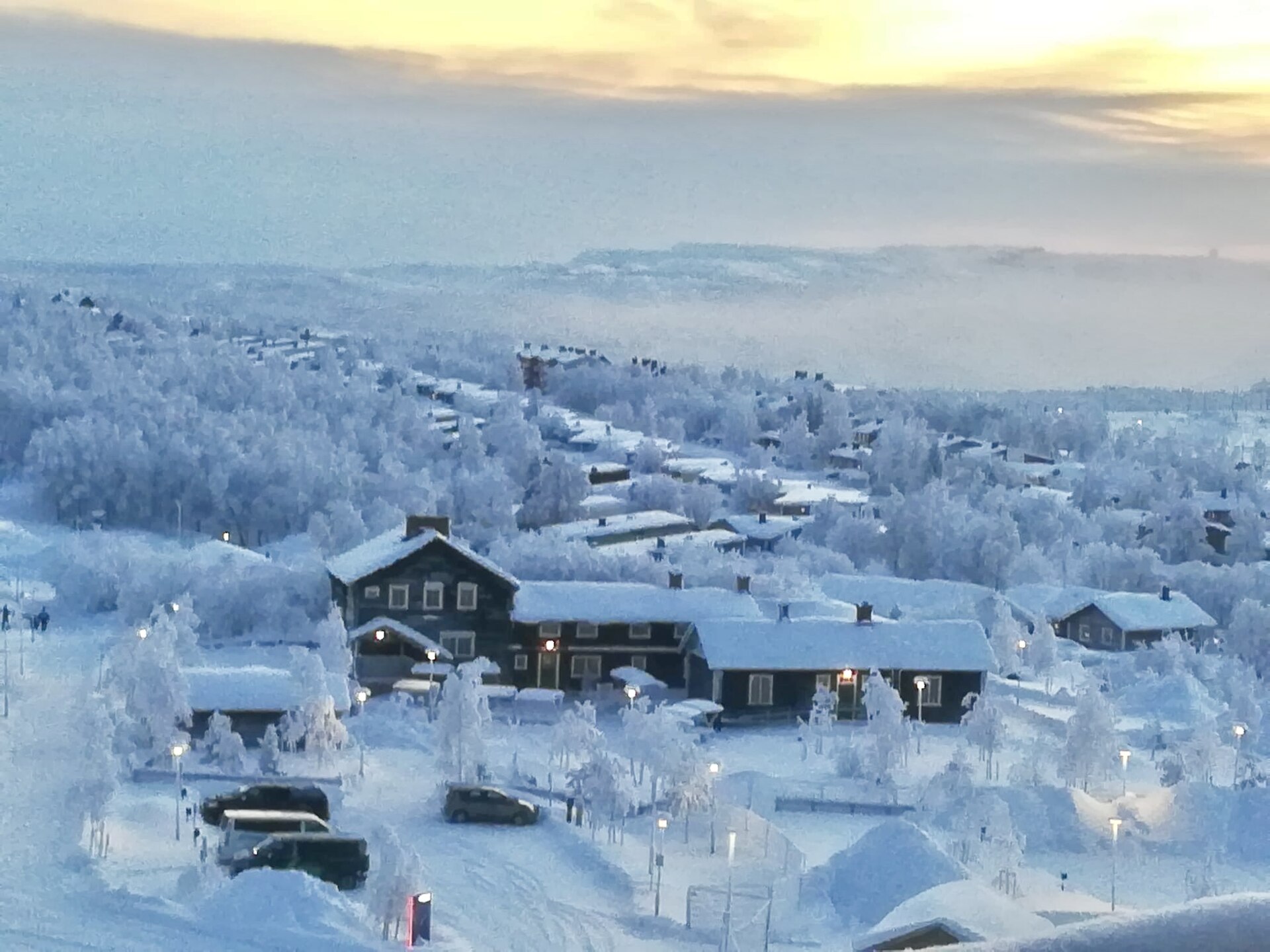
Sweden stretches from the farmland of Skåne to the mountains above the Arctic Circle, and the farther north you travel, the longer and colder the winter. In November, Malmö averages 5.5°C (42°F) and Stockholm 3.6°C (39°F), while Kiruna, up in Swedish Lapland, is already deep in winter at -6.8°C (20°F). In July the gap narrows: 18.7°C (66°F) in Stockholm against 13.2°C (56°F) in Kiruna, with daylight that hardly ends. The month you pick decides which Sweden you get: candlelit cafes and Christmas markets, snowfields lit by a sun that barely clears the horizon, or archipelago evenings that are still bright at 10 p.m.
How Sweden’s climate changes from Malmö to Kiruna
The south of Sweden has a mild, damp climate shaped by the sea. Neither Malmö nor Gothenburg has a meteorological winter in a normal year, because the daily mean does not stay below 0°C (32°F) long enough to count. Gothenburg is the wet one, with 912 millimeters (36 inches) of precipitation a year, against 658 millimeters (26 inches) in Malmö and 546 millimeters (22 inches) in Stockholm.
Stockholm sits in between, with winters that hover around freezing and pleasantly warm summers. In Swedish Lapland, winter is long. At Kiruna Flygplats, the weather station at the airport, winter arrives on average on October 12 and lasts 194 days. Abisko, a little farther north and west in the mountains, is slightly milder in midwinter than Kiruna and much drier, with 347 millimeters (14 inches) of precipitation a year against 561 millimeters (22 inches) at Kiruna Flygplats.
Sweden’s average temperature, month by month
Monthly mean temperature at three stations, Malmö A, Stockholm and Kiruna Flygplats, run by SMHI, the Swedish Meteorological and Hydrological Institute, as climate normals for 1991 to 2020. A normal is a 30-year average, so any single month can run milder or colder. The mean covers day and night, so afternoons are warmer and nights colder than these figures.
| Month | Malmö A | Stockholm | Kiruna Flygplats |
|---|---|---|---|
| January | 1.2°C (34°F) | -1.0°C (30°F) | -11.3°C (12°F) |
| February | 1.2°C (34°F) | -1.0°C (30°F) | -11.2°C (12°F) |
| March | 3.3°C (38°F) | 1.6°C (35°F) | -7.3°C (19°F) |
| April | 7.7°C (46°F) | 6.3°C (43°F) | -1.7°C (29°F) |
| May | 12.3°C (54°F) | 11.4°C (53°F) | 4.2°C (40°F) |
| June | 15.7°C (60°F) | 15.7°C (60°F) | 9.9°C (50°F) |
| July | 18.2°C (65°F) | 18.7°C (66°F) | 13.2°C (56°F) |
| August | 17.9°C (64°F) | 17.7°C (64°F) | 11.1°C (52°F) |
| September | 14.2°C (57°F) | 13.1°C (56°F) | 6.0°C (43°F) |
| October | 9.5°C (49°F) | 7.7°C (46°F) | -0.9°C (30°F) |
| November | 5.5°C (42°F) | 3.6°C (39°F) | -6.8°C (20°F) |
| December | 2.6°C (37°F) | 0.6°C (33°F) | -9.4°C (15°F) |
Average afternoon highs and night lows in November, February and July, from the same SMHI normals. SMHI’s Stockholm station sits at Observatoriekullen in the city center.
| Station | November | February | July |
|---|---|---|---|
| Malmö A | 7.6°C / 3.4°C (46°F / 38°F) | 3.5°C / -0.9°C (38°F / 30°F) | 22.7°C / 13.7°C (73°F / 57°F) |
| Stockholm | 5.4°C / 1.9°C (42°F / 35°F) | 1.2°C / -3.2°C (34°F / 26°F) | 23.6°C / 14.8°C (75°F / 59°F) |
| Kiruna Flygplats | -3.4°C / -10.6°C (26°F / 13°F) | -7.1°C / -16.1°C (19°F / 3°F) | 17.9°C / 8.7°C (64°F / 48°F) |
November is gray and mild in the south and already winter in Lapland
November is Sweden’s quiet month. In Stockholm, nights on average stay just above freezing and afternoons reach the low 40s Fahrenheit, so a warm coat is enough. Measured as monthly means, Gothenburg and Malmö are a little milder than Stockholm, at 5.1°C (41°F) and 5.5°C (42°F), but also wetter: Gothenburg collects 85 millimeters (3.3 inches) of precipitation in a normal November.
The days shorten fast. Stockholm has almost nine hours of daylight on November 1 and under seven by the end of the month. In December, Christmas markets and candlelit cafes fill Stockholm and Gothenburg.
In Kiruna, November is full winter, with afternoons below freezing and nights in the low teens Fahrenheit. Daylight drops from about seven hours on November 1 to under three hours by November 30, which makes the long, dark evenings good for northern lights if the sky is clear.
Winter brings deep snow to the north and short days everywhere
January and February are the coldest months across the country. Stockholm averages -1.0°C (30°F) in both. Snow comes and goes in the capital. According to SMHI, snow cover cannot be counted on to last the whole winter south of a line from central Värmland through southern Dalarna to central Gästrikland, a line that runs north of Stockholm. On Skåne’s south coast, snow cover on average does not form until some time in December or later.
Around the winter solstice Stockholm has about six hours between sunrise and sunset, and Malmö about seven. By the end of February the day in Stockholm has grown to about ten and a half hours.
In Lapland, this is the season of dog sledding, snowmobiles and the Icehotel. February in Kiruna averages -11.2°C (12°F), with nights around -16.1°C (3°F). The northern mountains and northern Lapland have snow on the ground for a little over 200 days in an average year, according to SMHI’s maps for 1961 to 1990. SMHI expects snow cover to last for shorter periods as the climate warms. In December the sun does not rise in Kiruna at all for three to four weeks around the solstice. It is not pitch dark, though: twilight lasts several hours, and snow on the ground makes it lighter.
Lapland keeps its snow in March and April while the light returns
Spring comes to Sweden in stages. In Malmö the average temperature reaches 7.7°C (46°F) in April, and in Stockholm 6.3°C (43°F). By May, Stockholm averages 11.4°C (53°F), and summer by SMHI’s definition arrives there on average on May 7.
In Kiruna, March still averages -7.3°C (19°F) and April -1.7°C (29°F), but the sunshine is back: according to SMHI, Kiruna normally gets 158 hours of sunshine in March and 202 in April, against none at all in December. The spring snow figures come from the same SMHI maps for 1961 to 1990. Most of Norrland, the northern half of Sweden, is free of snow by late April or at some point in May, while snow on the high fells can last into June. For skiing and snow activities under long, bright days, March and April are the months to look at.
Summer in Stockholm means highs in the mid-70s and sunsets after 10 at midsummer
July is the warmest month. Afternoons in Stockholm average 23.6°C (75°F), and Malmö and Gothenburg are similar. In a normal July, Malmö reaches 25°C (77°F) on about nine days and Gothenburg on seven or eight.
The long days define the Swedish summer. At midsummer the sun rises in Stockholm around 3:30 a.m. and sets after 10 p.m. According to SMHI, Stockholm normally gets 280 hours of sunshine in July, against 33 in December. Summer is also the wettest part of the year in Stockholm, with 62 millimeters (2.4 inches) of precipitation in both June and July and 66 millimeters (2.6 inches) in August.
In Kiruna, July averages 13.2°C (56°F), with afternoons in the mid-60s Fahrenheit. There the sun stays above the horizon around the clock from late May to mid-July, about seven weeks, the period known as the midnight sun. July is also Kiruna’s wettest month, with 104 millimeters (4.1 inches) of precipitation.
September and October cool quickly, and the north gets its first snow
September is still mild in the south, with a mean of 14.2°C (57°F) in Malmö and 13.1°C (56°F) in Stockholm, and fewer visitors than in summer. In October the mean falls to 7.7°C (46°F) in Stockholm, and it is Gothenburg’s wettest month, with 103 millimeters (4.0 inches) of precipitation.
Up north, autumn is short. In Kiruna the mean temperature falls below freezing in October, and in the valleys of the northernmost mountains the first snow cover normally forms in early October, according to SMHI’s maps for 1961 to 1990.
Pack for the region and the month, not for Sweden as a whole
A trip that combines Stockholm in February with a few nights in Kiruna spans more than 10°C (18°F) in average temperature, so plan your clothes for the coldest stop. For Lapland in winter, that means thermal layers, a warm hat, insulated boots and mittens. For Stockholm from November to March, a warm, waterproof coat and shoes with good grip. In summer, bring layers and a rain jacket, because even July evenings cool down.
Check the forecast from SMHI a few days before you travel, since the normals above describe the average, not the week you will be there. For the rest of the trip, from trains to money, start with our guide to planning a trip to Sweden. If you are heading north for the aurora, our guide to Swedish Lapland and the northern lights covers Abisko and Kiruna. Travelers who want a cool summer can read why Sweden has become a coolcation destination, a summer trip chosen for a cooler climate. Anyone planning around midsummer or Christmas should check which public holidays in Sweden close shops and change opening hours.
Last fact-checked: 13 November 2026